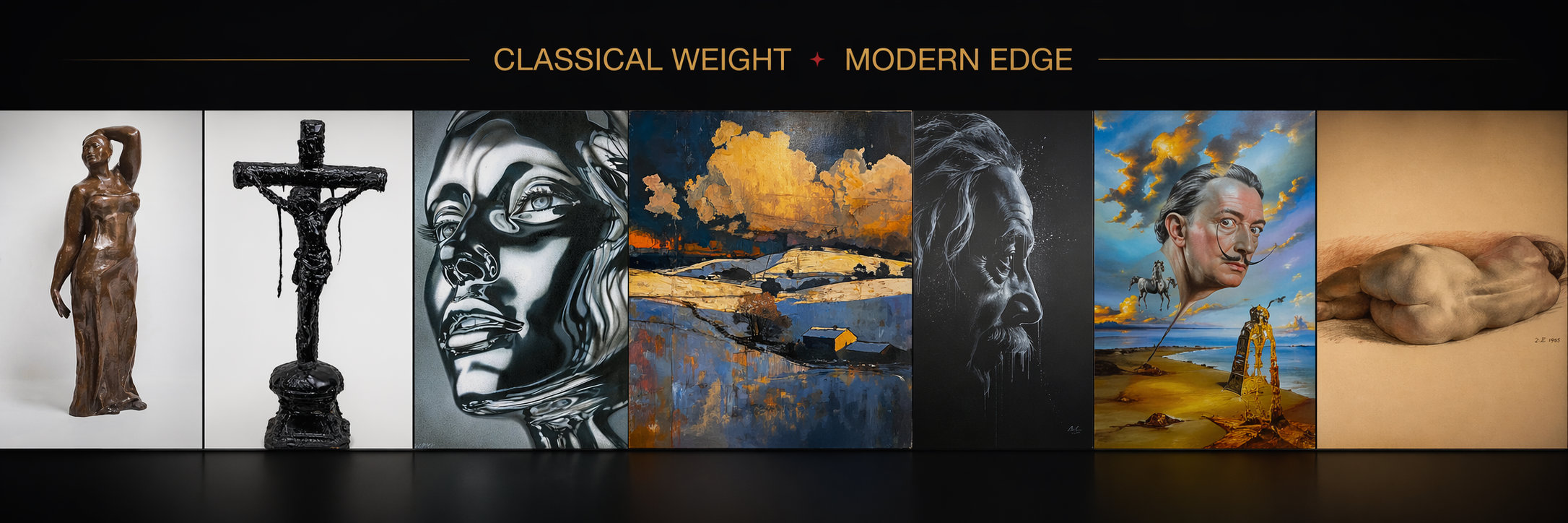
Curatorial Note
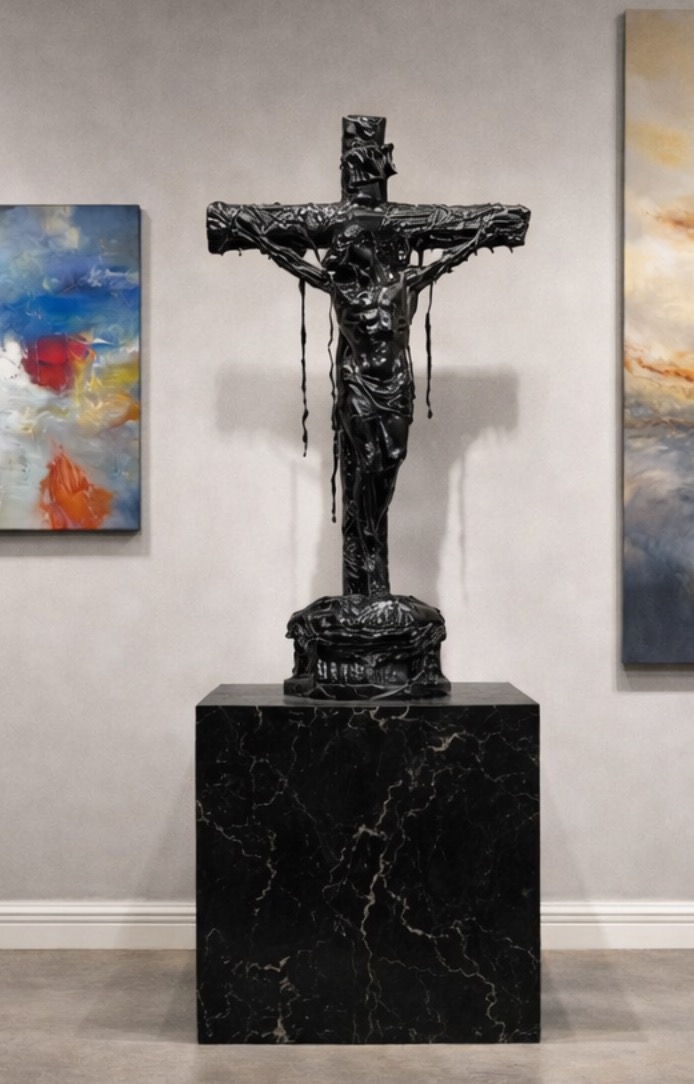
A charged early work from Mattia Biagi’s seminal Tar Work language, Crucifiction stands at the point where the artist’s signature material becomes both surface and theology. Biagi’s tar practice began in 2003 after his encounter with the La Brea Tar Pits in Los Angeles, where the preservative power of tar suggested a new ritual: ordinary and symbolic objects could be dipped, sealed, darkened, and transformed into new sculptural forms. In Biagi’s own description of the series, black tar crystallizes materials, exalts them beneath a tactile black coating, and turns selected objects into symbols capable of carrying a message.
Here, the crucifix — among the most enduring images of sacrifice in Western art — is recast in resin, fiberglass, and a proprietary tar mix. The figure, cross, drapery, wounds, and descending strands remain legible, but they no longer read as church furnishing or domestic devotional object. They become contemporary sculpture: fossil, relic, shroud, wound, and icon at once. The black surface shifts between opacity and mirror, matte and gloss; in light, it flashes like obsidian, while the hanging tar reads as wax, tears, blood, or time itself.
This is where the work becomes special. Biagi’s tar does not simply cover the crucifix; it changes the object’s spiritual temperature. A 2011 Skira-published Black Tar text frames Biagi’s religious imagery as a deeply personal reflection on faith, sacrifice, darkness, and hope. In that text, the black-tar crucifix is not treated as blasphemy, but as an image that calls the viewer back into a spiritual conversation — a dark icon for an age of material excess and decay.
That religious thread was not peripheral in Biagi’s career. His 2010 London exhibition, Recognize Your Spiritual Need, presented tar-dripped sculptures as a call to re-examine contemporary spirituality, explicitly describing the message as universal rather than dogmatic. Works such as Jesus Save Me were framed around the recovery of spiritual values in a chaotic, profit-oriented society.
Within Biagi’s history, this sculpture belongs to the foundational period of the Black Tar / Tar Work practice. It sits at or near the origin point of the series — 2003 — before the artist’s major black-tar exhibition cycle of 2008–2011 and before his later expansions into chandeliers, sculptural installations, collage-furniture, and immersive design environments. Biagi’s later work repeatedly returns to the same core concerns visible here: preservation, transformation, memory, life and death, and the reactivation of symbolic objects.
The provenance deepens the object’s resonance. BAG’s records place the sculpture in the Elton John Atlanta / Peachtree Road estate. Public sources confirm the cultural weight of that Atlanta residence: People reported that John listed his 13,332-square-foot, two-story Atlanta condo, made from six combined units, after owning it for more than 20 years; Christie’s later announced Goodbye Peachtree Road, an eight-sale presentation of works of art, objects, and memorabilia from John’s former Atlanta home. Separately, L’Italo-Americano reported that Biagi’s works had been purchased by celebrities including Elton John, which makes the BAG provenance contextually coherent, though the exact object-level estate documentation should remain on file.
Inquire Privately
For pricing, additional imagery, or to arrange a viewing, please contact us.
Braselton Art Gallery is a fine art gallery serving collectors throughout Braselton, Northeast Atlanta, Gwinnett County, and the greater Atlanta area.